
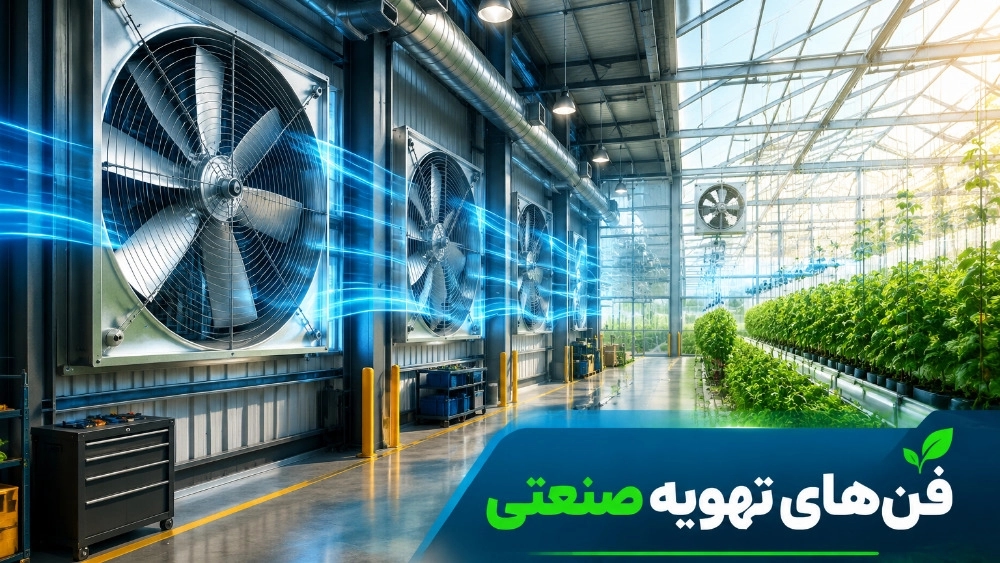
The conditions of each industrial environment are different from another environment. A welding shop may require a fume and pollutant exhaust system, while in a manufacturing shed, the primary goal is to reduce heat build-up and provide proper air circulation. Controlling temperature, humidity and air flow is also very important in the greenhouse. For this reason, one model of industrial ventilation fan cannot be considered suitable for all environments.
In this article, we examine the types of industrial ventilation fans, their use in workshops, sheds and greenhouses, selection criteria, factors affecting the price and important points when buying. You will also get to know the capabilities and benefits of cooperation with Faraz Shiraz Air Conditioning.
What is an industrial ventilation fan?
Industrial ventilation fan is a mechanical device for moving and transferring a large volume of air in industrial, commercial, agricultural and construction environments. These fans are usually used to discharge hot and polluted air, provide fresh air, reduce humidity, create air circulation and control environmental conditions.
Industrial fans are designed for continuous operation and tougher conditions compared to regular home or commercial fans. Engine power, ventilation capacity, body material, propeller type, efficiency and operability in different environmental conditions are important features in their design.
The right choice of industrial ventilation fan should be done according to the volume of the space, the type of pollutant, the ambient temperature, the humidity level, the number of people present, the type of activity and the purpose of ventilation.
Why is industrial ventilation important in workshops?
Workshops are usually places where activities are carried out that can generate heat, smoke, steam, dust or various gases. In the absence of proper ventilation, pollutants remain in the environment and indoor air quality decreases.
Using a suitable industrial ventilation fan can help exhaust polluted air and bring in fresh air. For example, in welding, cutting and turning workshops, controlling smoke and suspended particles is very important. In production workshops, the heat caused by machinery may also increase the ambient temperature.
A proper ventilation system should be able to remove bad air from the place of pollutant production and at the same time provide suitable conditions for fresh air to enter.
Advantages of using a ventilation fan in the workshop
Using an industrial ventilation fan in the workshop can have several advantages:
- Decreasing the accumulation of hot air
- Evacuating smoke and vapors
- Reducing dust and pollutants
- Creating proper air flow
- Increasing the comfort of employees
- Helping to control the ambient temperature
- Decreasing humidity in appropriate conditions
- Helping to increase the life of some equipment
Of course, for special or dangerous pollutants, the fan alone is not always enough and a local suction system, filtration or specialized equipment may be needed.
Industrial ventilation fan in sheds
Soles usually have a large volume, high ceiling height and wide interior space. In such environments, hot air tends to accumulate in higher parts. If the air circulation and evacuation is not done properly, the temperature inside the shed can increase significantly.
Using a shelter ventilation fan is one of the common ways to improve air circulation and discharge. The selection of the fan should be based on the size of the shed, height, type of activity, number of sources of heat generation and climatic conditions.
In production sheds, warehouses and industrial halls, axial fans, industrial exhaust fans, ceiling fans or combined systems may be used.
The importance of ventilation in industrial sheds
In an industrial shed, there may be different sources of heat or pollutants. Machines, furnaces, production lines, industrial engines and employee activities can all affect indoor air conditions.
Industrial ventilation fan can help create better conditions by exhausting inappropriate air. However, the optimal performance is achieved when the replacement air also enters the shed in a suitable way.
One of the common mistakes is to install only too many exhaust fans, without checking the fresh air intake. Such a system may not have optimal efficiency.
What is the use of the greenhouse ventilation fan?
The greenhouse is a sensitive environment and the control of its internal conditions is different from a workshop or a shed. Temperature, humidity, carbon dioxide, air flow and plant growth conditions should be managed in the appropriate range.
Greenhouse ventilation fan is used to exhaust hot air, create air flow and help control temperature and humidity. In many greenhouses, fans are used alongside cooling pads or other ventilation equipment.
Choosing the greenhouse fan capacity should be done based on the size of the greenhouse, type of product, climatic conditions, type of structure and cooling method.
Why is greenhouse ventilation important?
Excessive increase in temperature or humidity can create unfavorable conditions for plant growth. Proper air circulation can also help make the conditions inside the greenhouse more uniform.
Of course, excessive ventilation may also cause energy loss or disruption of optimal growth conditions in some situations. Therefore, the capacity of the industrial ventilation fan or greenhouse should be chosen according to the actual need.
Types of industrial ventilation fans
Industrial fans are divided into different types in terms of structure and application. Choosing any type of fan depends on the project conditions.
Industrial axial fan
Axial fans are used to move a large volume of air and are used in many sheds, workshops and greenhouses.
These fans can be used for direct air evacuation from the environment and are produced in different models in terms of diameter, power and ventilation capacity.
Industrial exhaust fan
Exhaust fan is used to discharge the air inside and transfer it outside the environment. These fans are widely used in workshops, industrial halls, warehouses and some agricultural environments.
At the time of buying an industrial ventilation fan, the specifications of the exhaust fan should be checked, including ventilation capacity, static pressure, engine power and installation conditions.
Industrial centrifugal fan
Centrifugal fans are usually used in situations where there is a need for higher pressure or air transfer from channel paths. This type of fan can be used for industrial suction systems, duct ventilation and air transfer.
Selecting a centrifugal fan requires checking the performance curve and the required pressure and flow rate of the system.
Industrial ceiling fan
Ceiling fans can be used to exhaust hot air and provide ventilation in large halls. These fans are installed in some sheds and workshops and can help to improve the environment by removing the hot air accumulated in the height.
The most important criteria for choosing an industrial ventilation fan
Choosing an industrial ventilation fan should be based on several main parameters.
1. The volume of the environment
The first issue that should be checked is the size of the desired space. The length, width and height of the environment play a role in calculating the air volume.
The larger the volume of the hall, the required ventilation capacity can also increase.
2. Air exchange rate
The number of times the air in an environment should be changed in a certain period of time is one of the important parameters of ventilation design. The required amount depends on the type of activity and environmental conditions.
For example, the ventilation requirement of a simple warehouse is not the same as a welding workshop.
3. Dubai air
The flow rate is one of the main technical characteristics of the industrial ventilation fan and is usually expressed in units such as cubic meters per hour.
When comparing two fans, air flow should be checked along with pressure and other performance characteristics.
4. static pressure
If the fan is connected to a duct, filter, valve or other equipment, the resistance of the system becomes important. In such a situation, it is not enough to check the flow rate of the fan and the required static pressure must also be calculated.
5. engine power
Motor power is one of the important specifications of the fan, but it should not be the only selection criterion. The fan must be able to provide the required flow rate and pressure at the desired working point.
Choosing a motor with more power than needed may increase energy consumption and operating costs.
6. Environmental conditions
High temperature, humidity, dust and corrosive materials can affect the choice of fan.
For harsh industrial environments, body material, engine type, protection class and parts quality should be selected according to working conditions.
The effect of proper ventilation design on energy consumption
One of the important goals in the design of industrial ventilation systems is to create a balance between proper performance and energy consumption.
If the fan capacity is selected more than the actual need, the power consumption will increase. On the other hand, a fan smaller than the required capacity cannot create favorable conditions and may have to work for a longer time.
For this reason, choosing the correct industrial ventilation fan can play an important role in controlling operating costs.
Using engines with appropriate efficiency, remote control system and control equipment can help manage energy consumption in some projects.
The price of an industrial ventilation fan depends on what factors?
The price of an industrial ventilation fan depends on various factors and it is not possible to set the same price for all models.
The most important effective factors are:
- Aeration capacity
- Motor power
- Impeller diameter
- Fan type
- Body material
- Motor type
- Manufacturing quality
- Control equipment
- Customization conditions
- Parts brand
- Application type
So when comparing the price, it is better to compare the technical specifications of several products. The cheapest product is not necessarily the most economical option.
Why is it important to buy an industrial ventilation fan from a specialized manufacturer or collection?
Industrial ventilation is a specialized system and the selection of equipment should be done according to the actual conditions of the project. Buying a fan without checking the required capacity can cause poor performance or increase energy costs.
A specialized collection can help in choosing the right model, capacity, engine type and technical specifications.
Faraz Shiraz ventilation fan; A choice for industrial ventilation projects
Faraz Shiraz ventilation fan focusing on the field of ventilation equipment can be considered for projects such as workshops, industrial sheds, production halls, warehouses and greenhouses.
One of the important advantages of cooperating with a specialized group is the possibility of checking the actual needs of the project before choosing the equipment. Instead of making a decision based only on the diameter or power of the fan, parameters such as space volume, working conditions, required flow rate and installation method are also checked.
If you are looking for purchasing an industrial ventilation fan for your project, providing information such as the dimensions of the environment, ceiling height, type of activity, approximate temperature, amount of pollutants and installation conditions to Faraz Shiraz ventilation fan experts can help to choose the equipment more accurately.
Important points when buying an industrial ventilation fan
Before placing an order, it is better to check these items:
- The exact volume of the environment should be determined.
- The main purpose of ventilation should be determined.
- The required ventilation capacity should be calculated.
- Static pressure should be checked if there is ducting.
The difference between ventilation fan in workshop, shed and greenhouse
Although all three environments need ventilation, their purpose and conditions are different.
In workshops it is usually more important to discharge heat, smoke, dust and pollutants. In soles, the large volume of space and the height of the ceiling make the design of air flow to be particularly important. In greenhouses, controlling temperature and humidity and maintaining suitable conditions for the growth of plants is one of the most important goals of ventilation.
Industrial ventilation fan maintenance and service
After buying and installing the fan, proper maintenance is very important. Accumulation of dust on the impeller, loosening of connections, wear of the belt in belt models and problems related to the motor can reduce the performance of the fan.
Periodical visit, cleaning parts, checking connections and checking the condition of the engine are measures that can help increase the life of the equipment.
In industrial environments where the fan operates many hours of the day and night, a regular service and maintenance program is more important.
summary
Industrial ventilation fan is one of the important equipments for controlling the air conditions of workshops, sheds, production halls, warehouses and greenhouses. Choosing the right fan can help to discharge hot and polluted air, create air circulation, control humidity and increase the comfort of the environment.
However, choosing a fan should not be based solely on price or motor power. The volume of the environment, required flow rate, static pressure, type of use, environmental conditions, type of pollutant, installation method and energy consumption should all be considered in the selection process.
If you are looking to buy an industrial ventilation fan for a workshop, shed or greenhouse, it is very important to check the specifications of the project before buying. Faraz Shiraz ventilation fan can be considered as an active group in the field of ventilation equipment, to check the needs of the project and choose the equipment according to the environmental and technical conditions.
To receive guidance and choose the right fan, it is better to provide the complete specifications of the project so that the capacity and model of the fan can be determined based on actual needs.
Choosing the best fan depends on the volume of the shed, the height of the ceiling, the type of activity, the amount of heat and the pollutants produced. Axial fan, exhaust fan and ceiling fans are common options for ventilation of the shed.
The type of fan depends on the activity of the workshop. For environments with smoke, vapor or dust, a local exhaust system and filtration equipment may be required in addition to the general ventilation fan.
In order to choose the right capacity, the volume of the environment, the amount of air exchange required, the type of activity, the amount of heat production and pollutants, and the conditions of air entry and exit should be checked. It is better to choose the capacity with technical calculations.